
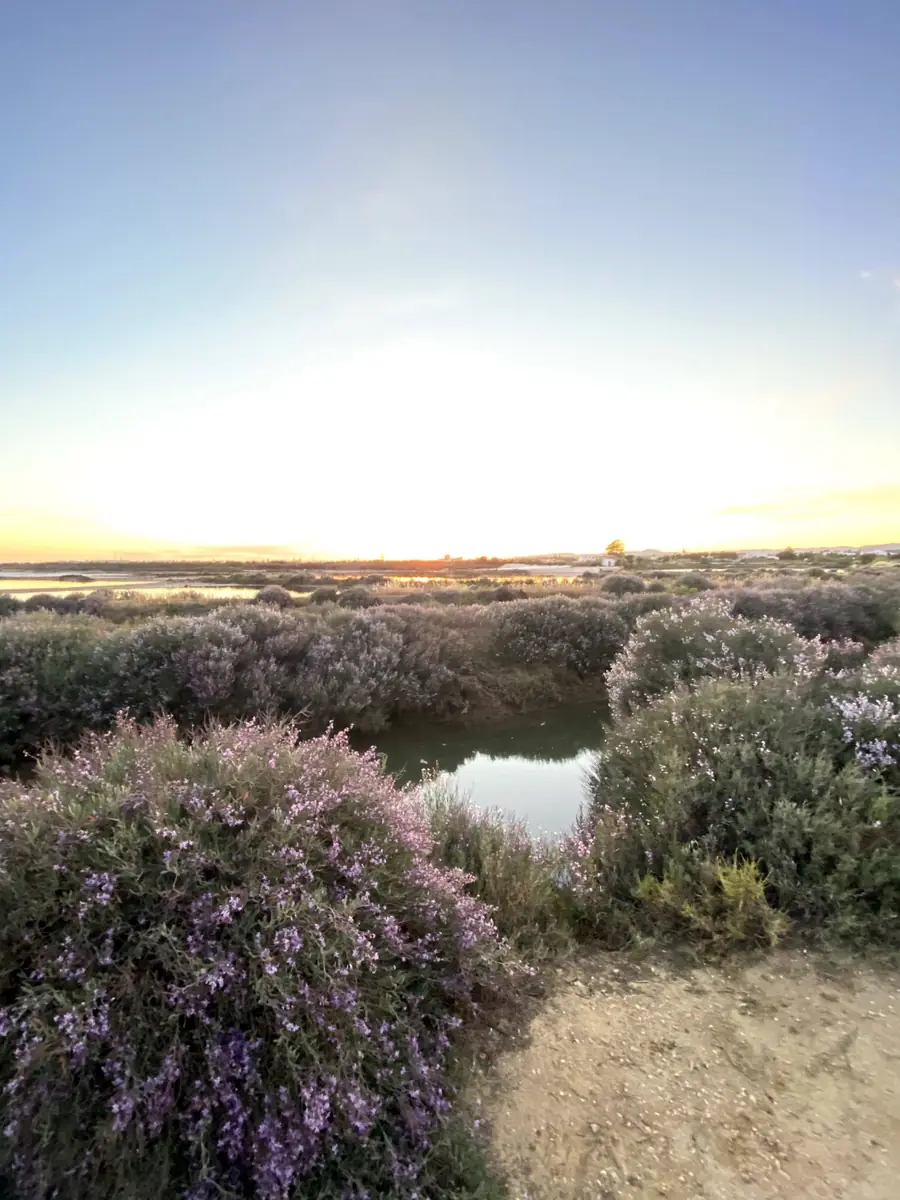
The Ria Formosa Natural Park protects the lagoon, barrier islands, salt marsh and birdlife between Ancão and Manta Rota, across five boroughs including Olhão. On the islands, stay on the boardwalks, do not camp or light fires, take your rubbish home and gather shellfish by hand and in daylight only.
The Ria Formosa Natural Park is the protected area covering the lagoon, its barrier islands and its shores from Ancão to Manta Rota, across five boroughs: Loulé, Faro, Olhão, Tavira and Vila Real de Santo António. It was created in 1987 and is managed by ICNF, the national conservation agency. If you are heading to the islands, the practical rules fit in one line: stay on the boardwalks, no camping and no fires, take your rubbish home, gather shellfish by hand and in daylight only, and keep out of fenced-off bird areas.
What the park is and how long it has existed
The lagoon was first made a Nature Reserve in 1978 and joined the Ramsar list of wetlands of international importance in 1980. The Natural Park itself was created by Decree-Law 373/87 of 9 December, to protect the lagoon system, its wildlife and its migratory birds. Today's rules are set out in the park's management plan, approved by Council of Ministers Resolution 78/2009.
According to ICNF, the park covers 17,900.77 hectares. The lagoon is only 2 metres deep on average and, at low water on spring tides, around 80% of its bed is exposed. That is why the tide shapes almost everything you do here: check the Olhão tide times before you set off.
What it protects
- Barrier islands and dunes. From west to east: the Ancão peninsula, the islands of Barreta, Culatra, Armona, Tavira and Cabanas, and the Cacela peninsula, with six tidal inlets between them.
- Salt marsh. Flooded at high tide and exposed at low tide. ICNF calls it a nursery: many fish, molluscs and crustaceans spend their early life here.
- Birds. In winter, large numbers of waterbirds arrive from northern Europe. The park's emblem is the purple swamphen, and the little tern nests on the dunes and in the salt pans.
- Seahorses. IPMA, the national sea and weather institute, describes a sharp decline in recent decades caused by illegal fishing and habitat damage. A safeguard plan has set up refuge areas, and recent monitoring shows encouraging signs of recovery.
- Seagrass meadows. The 2026 fishing rules for the Ria Formosa single out seagrass as a sensitive ecosystem that can justify banning certain fishing gear.
What you must not do
Article 7 of the management plan bans, among other things:
- camping or caravanning outside designated sites;
- lighting fires or burning vegetation, except where facilities are provided;
- leaving rubbish anywhere other than proper bins;
- driving or parking motor vehicles on beaches, dunes and tidal areas;
- picking or disturbing protected species, including nests and eggs;
- spearfishing, and scuba diving outside authorised training, research or monitoring.
Breaking these rules is an environmental offence. We are not quoting fine amounts, as they depend on the case and its seriousness.
Dunes, boardwalks and closed areas
The dunes hold the islands together, so cross them only on boardwalks and marked paths. Some zones have full protection and can only be entered with ICNF permission, including part of Armona, between Armona and Fuseta. Bird nesting areas are set each year by public notice: if you see fencing or signs on the sand, walk around them.
Boats, speed and anchoring
The plan sets out navigation channels. In the main ones, such as the Olhão channel and Olhão to Armona, the limit is 25 knots. On the secondary route linking Armona, Barra Grande and Culatra, boats must be under 9 metres and travel below 15 knots. Outside the channels, only local fishing boats, shellfish farm boats, non-motorised craft and authorised vessels may go, at 10 knots at most. The plan also sets designated anchorages. Kayaking, sailing and paddleboarding are allowed everywhere except in fully protected zones. For ferry times, see our ferries guide.
Clam digging and recreational fishing
- Gathering by hand only. Without tools you need no licence. With a clam knife, rake or any other tool, you need a recreational fishing licence from DGRM, the fisheries authority.
- Daylight only. Since August 2026, from sunset to sunrise you may not gather shellfish or fish from a boat.
- Two rods at most per person, and no spearfishing.
- Not everywhere. Gathering is banned in fully protected zones and in type I partial protection zones.
- Before you eat any shellfish, check on the IPMA website that the harvesting area is open.
Dogs and drones
The park's regulations mention domestic animals only to ban them from shellfish farms. Elsewhere, keep your dog close, away from birds and fenced areas, and follow the rules posted at each beach.
The plan does not mention drones by name, but any flight by powered aircraft below 1,000 feet requires ICNF's opinion, and Faro airport is right next door. Ask the park before you fly.
Quinta de Marim: the park's base in Olhão
The park's headquarters is the Marim Environmental Education Centre, in Quelfes, on the eastern edge of Olhão by the EN125 road and the campsite. ICNF recommends starting your visit here. It has an easy circular trail of about 2.9 km, and the 1916 Chalet João Lúcio stands nearby. Opening times, how to get there and what to see are in our Quinta de Marim guide.
What this means for your island trip
- Bring a rubbish bag and carry everything back to the mainland.
- No tents, camping stoves or beach fires.
- Stick to the boardwalks, especially on Armona and Culatra.
- If you want to gather clams, do it by hand, in daylight and away from protected zones.
- To pick a beach, see our guide to Olhão's Blue Flag beaches.
- To report damage to nature, call SOS Ambiente on 808 200 520. In an emergency, dial 112.
Frequently asked questions
Can I camp on the Ria Formosa islands?
No. The park's management plan bans camping and caravanning outside designated sites. If you want to sleep near the lagoon, use a campsite or accommodation on the mainland.
Can I have a fire or a barbecue on the beach?
No. Fires and burning are banned in the park except where facilities are provided. Bring food that is ready to eat.
Can I dig for clams in the Ria Formosa?
Only by hand, in daylight and outside fully protected and type I partial protection zones. You need no licence without tools; with a clam knife or rake you need a DGRM recreational fishing licence. Check IPMA before eating anything you gather.
Can I fly a drone over the Ria Formosa?
Ask the park first. The plan requires ICNF's opinion for powered aircraft flying below 1,000 feet, and Faro airport is right next door.
Can I bring my dog to the islands?
The park's rules only ban domestic animals from shellfish farms. Keep your dog close, away from birds and fenced areas, and follow the rules posted at each beach.
Where is the Ria Formosa Natural Park headquarters?
At the Marim Environmental Education Centre in Quelfes, on the eastern edge of Olhão by the EN125. Contact: +351 289 700 210 or pnrf@icnf.pt.
This guide is for information only and was checked on the date shown. Times, prices and rules can change: always confirm with the official sources before you go. If something is out of date, tell us on Instagram @olhaolovers.
Sources
- ICNF: Parque Natural da Ria Formosa (classificação, caracterização, estatutos, fauna, património)
- Diário da República: Decreto-Lei n.º 373/87, cria o Parque Natural da Ria Formosa (versão consolidada)
- Diário da República: Resolução do Conselho de Ministros n.º 78/2009, Plano de Ordenamento do Parque Natural da Ria Formosa
- ICNF: Atividades de turismo de natureza no Parque Natural da Ria Formosa (quadro do Plano de Ordenamento)
- Natural.PT (ICNF): Parque Natural da Ria Formosa, contactos e apoios ao visitante
- Natural.PT (ICNF): Informação sobre o PNRF e 2 percursos, incluindo o Percurso do Centro de Educação Ambiental de Marim (PDF)
- Natural.PT (ICNF): Informação de bolso sobre o Parque (PDF)
- ICNF: Código de conduta e boas práticas dos visitantes nas áreas protegidas (PDF)
- IPMA: Viagem pela Ria Formosa, 12 de novembro de 2025 (plano de salvaguarda dos cavalos-marinhos)
- DGRM: Portaria n.º 328/2026/1, normas da pesca comercial e lúdica na ria Formosa (PDF)
- DGRM: Perguntas frequentes sobre pesca lúdica 2026 (PDF)
- IPMA: Estado das zonas de produção de moluscos bivalves