
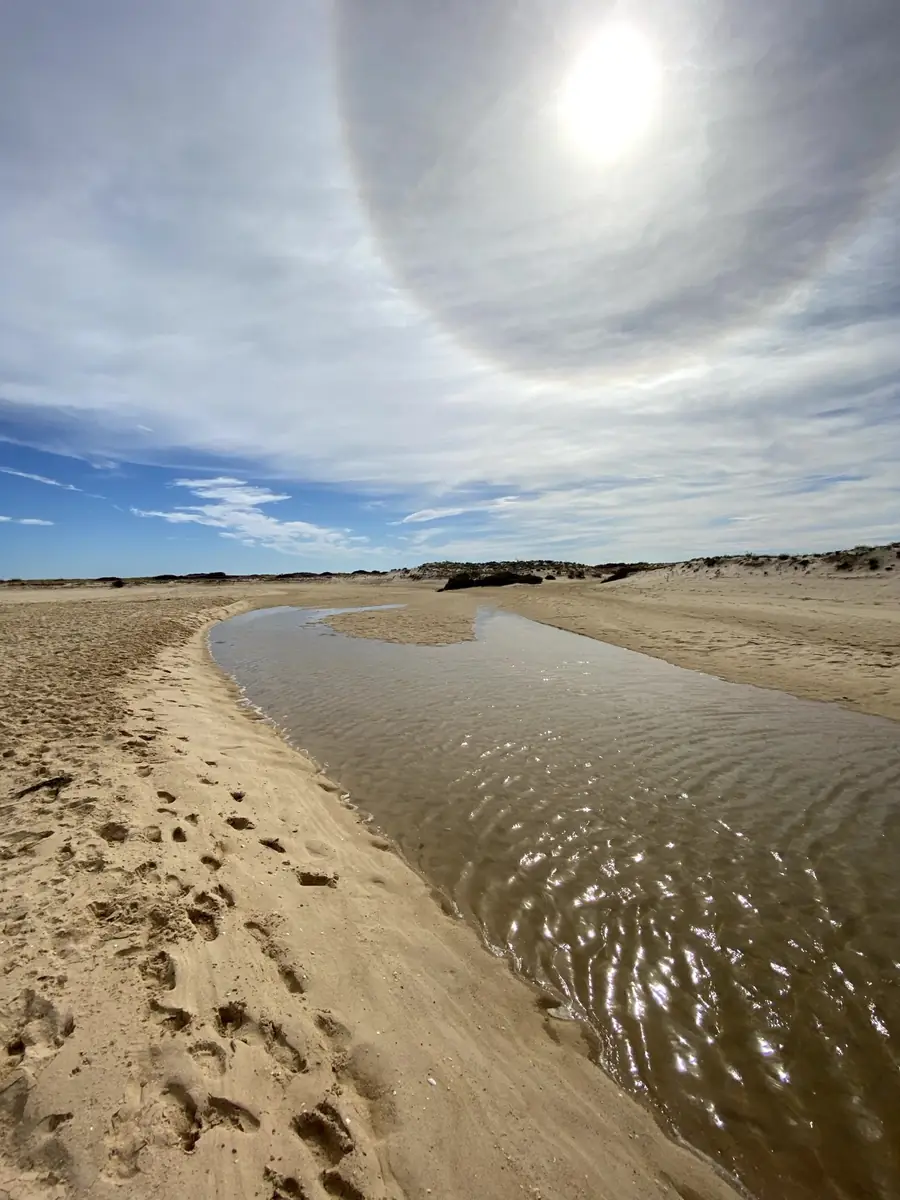
The Ria Formosa has two high tides and two low tides a day, each arriving about 50 minutes later than the day before. Heights are measured from chart datum (mean sea level is 2.00 m): below 0.8 m sandbanks appear, and above 3.2 m you are into spring tides.
The Ria Formosa gets two high tides and two low tides a day, a little over six hours apart, and each day they come round about 50 minutes later than the day before. Heights in a tide table are measured from chart datum, a level set below the lowest tide expected, so they are never negative: mean sea level sits at 2.00 m. A low tide under 0.8 m uncovers large sandbanks; a high tide above 3.2 m means spring tides. Check today's times on our tides page.
High water, low water, flood and ebb
Portugal's Hydrographic Institute (IH), part of the Navy, defines the tide as the rise and fall of the sea caused mainly by the pull of the Moon and the Sun, with a share down to the weather. High tide is the top of the rise, after the flood. Low tide is the bottom, after the ebb.
Between the two comes a short pause, slack water, when the level barely moves and the current turns. According to the IH, this is when the tidal current in the channels drops to zero.
Why there are two tides a day
The Moon takes about 24 hours and 50 minutes to return to the same point in the sky, which is known as the lunar day. In that time you get two highs and two lows, a pattern the IH calls a semi-diurnal tide, typical of the Portuguese coast. In practice:
- from one high tide to the next is about 12 hours 25 minutes;
- from high to low is a little over 6 hours;
- from one day to the next, everything shifts about 50 minutes later.
If low tide is late morning today, a week from now it will be late afternoon. There is no fixed tide time, so look at the table for the day you want.
Spring tides and neap tides
How big the tide is changes through the month with the Moon. According to the IH:
- Spring tides happen around the new Moon and the full Moon. Sun and Moon pull together, so highs are higher and lows are lower. Nothing to do with the season.
- Neap tides happen around the first and last quarter. The two pulls partly cancel out and the gap between high and low water is small.
The cycle repeats roughly every fortnight. A full Moon on the calendar means very low tides a few days later.
Chart datum and what the heights mean
Every height in the IH tide tables and on Portuguese nautical charts is measured from chart datum. On Portuguese charts it sits below the lowest predicted astronomical tide, which is why heights are always positive. On the mainland, chart datum is 2.00 m below the adopted mean sea level (Cascais, 1938). A tide of 2.0 m is therefore right at mean sea level.
On our tides page we use two simple markers:
| Height | What it means in the lagoon |
|---|---|
| Low tide under 0.8 m | Large sandbanks and mudflats uncovered |
| High tide over 3.2 m | Spring tides, with stronger currents at the inlets |
Height is not depth. To work out how much water there is at a given spot, the IH says to add the tide height to the depth shown on the nautical chart.
Predictions only cover the astronomical tide. Weather moves the sea too: low pressure raises the level (roughly 9 cm for every 10 hPa drop, according to the IH), and so does a strong onshore wind. An offshore wind leaves the water lower than forecast.
The inlet and the pier: the tide arrives later inside
The reference port in the official table is the Faro-Olhão inlet, whose tide gauge, now out of service, stood on the Culatra Island pier. Inside the lagoon the tide takes time to spread through the channels. At Olhão pier the difference is a few minutes, more noticeable at low water than at high water. Further in, at Faro, the delay is longer. The IH publishes these local corrections and warns that they are approximate.
One more detail: the IH tables are in UTC. In winter that matches mainland Portuguese time; during summer time you need to add an hour. Our page already shows Portuguese time.
What it means for your day
- Beach. On the lagoon beaches, such as Armona-Ria or Fuseta-Ria, low tide pulls the water back and leaves mud and channels. For a swim, aim for the hours around high tide. Currents near the inlets are usually very strong, and more so on spring tides.
- Walks. A spring low tide is the time to wander across the sandbanks and watch birds feeding on the mudflats. Head back before the flood: channels fill fast and can cut off your way back.
- Shellfish gathering. According to DGRM, the fisheries authority, gathering by hand needs no licence; using a shellfish knife, spade or other tools needs a shore fishing licence. Before you gather clams or cockles, check on the IPMA website whether the area is closed. Respect minimum sizes and keep off the clam farms.
- Boats. Olhão council warns that island ferry times can shift with the tides. Always check at the pier and see our ferries page.
Our tides page and the official table
Our Olhão tide times page shows high and low tide for today and the next seven days, and whether the tide is coming in or going out right now. It is a forecast calculated by Olhão Lovers with NASA's GOT5.5 tide model and adjusted against the Hydrographic Institute's official 2026 table: for 95% of tides the difference is under 11 minutes.
Use it to plan a beach day, a walk or a spot of shellfish gathering. It is not for navigation. If you are taking a boat out, use the official Hydrographic Institute tide tables and nautical charts, and check the sea forecast from IPMA before you leave.
Frequently asked questions
How many tides a day are there in the Ria Formosa?
Two high tides and two low tides, over a cycle of about 24 hours and 50 minutes. That is why each tide comes round about 50 minutes later than the day before.
What are spring tides and neap tides?
Spring tides have the biggest range and happen around the new and full Moon. Neap tides have the smallest range and happen around the first and last quarter. The cycle repeats roughly every fortnight.
Why are tide heights never negative?
Because they are measured from chart datum, which on Portuguese charts sits below the lowest predicted tide. On the mainland, mean sea level is 2.00 m above that datum.
At what tide height do the sandbanks appear?
On our tides page we use 0.8 m as the marker: below that, low tide uncovers large sandbanks and mudflats in the lagoon.
Is the tide at Olhão at the same time as at the inlet?
Nearly. At Olhão pier the tide arrives a few minutes after the Faro-Olhão inlet, with a bigger gap at low water. Further into the lagoon, as at Faro, the delay is longer.
Can I use the Olhão Lovers tides page for navigation?
No. It is our own forecast, good for planning your day. For navigation, use the Hydrographic Institute's official tide tables and nautical charts.
This guide is for information only and was checked on the date shown. Times, prices and rules can change: always confirm with the official sources before you go. If something is out of date, tell us on Instagram @olhaolovers.
Sources
- Instituto Hidrográfico (Marinha): Tabela de Marés 2026, Volume I (generalidades, níveis de referência, concordâncias, notas da Barra de Faro-Olhão, glossário)
- Instituto Hidrográfico: Tabela de Marés
- Instituto Hidrográfico: Previsão oceanográfica, altura de maré
- Instituto Hidrográfico: Zero Hidrográfico em Portugal (EPSG 10349)
- IPMA: Estado das zonas de produção de moluscos bivalves
- IPMA: Previsão marítima costeira
- DGRM: Perguntas frequentes sobre pesca lúdica (2026)
- Câmara Municipal de Olhão: Praias (horários dos barcos sujeitos às marés)
- Visit Olhão: Ilha da Armona (correntes junto à barra)