
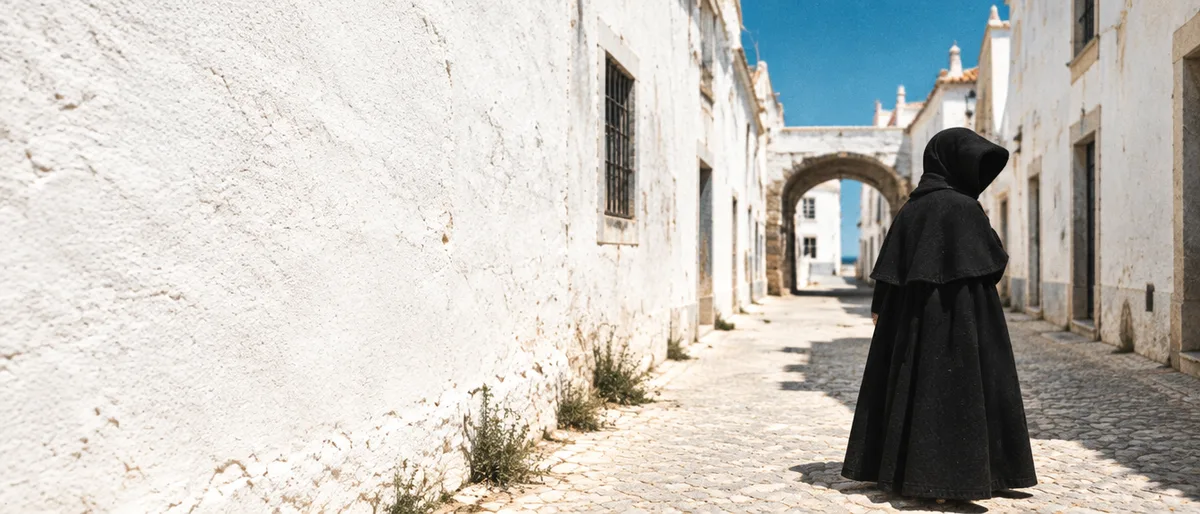
The bioco was a long black cloak, drawn over the head so that it hid the face. Faro's civil governor banned it in 1892, yet in Olhão women kept wearing it for decades: the Municipal Archive holds photos from 1947 and 1948 of women in biocos at the door of the main church.
For generations, the women of Olhão went out wrapped in a black cloak that covered them from head to toe. It was called the bioco. It was banned by law, dismissed as a mask and defended as a kind of freedom. And in Olhão it lasted far longer than anywhere else in the Algarve.
What was the bioco?
A wide black cloak reaching down to the feet, thrown over the head so that it formed a deep hood in front of the face. Passers-by saw a dark figure and little else: the woman inside could see without being seen.
The Portuguese writer Raul Brandão described it in Os Pescadores (The Fishermen, 1923), in his chapter on Olhão: "The cloak, very full and thrown elegantly over the head, made them impenetrable. It is a mysterious and alluring costume." Alongside the bioco, Olhão's women wore shoes Brandão calls cloques, which went "clock-clock" on the paving stones.
The 1892 ban
On 6 September 1892, Faro's civil governor, Júlio Lourenço Pinto, brought in new police regulations for the district. Article 32 read: "The wearing of so-called rebuços or biocos is forbidden in the streets and churches of every town in this district." The next article also caught men who dressed up as women.
To the governor, the bioco was a "mask" of "sepulchral black" that let people walk the streets without being recognised. It wasn't the first attempt either: laws against face-covering cloaks had been passed back in 1649, and nobody paid them much attention.
The 1892 ban didn't make the bioco vanish overnight. Across the Algarve, many women swapped it for a black shawl round the shoulders and a headscarf tied under the chin. Not in Olhão.
"They look like ghosts"
Raul Brandão passed through Olhão and left the best-known picture of the bioco:
"Not long ago they all wore cloques and the bioco. [...] When they go out, in black, wrapped in their biocos, they look like ghosts. They pass by, they look at us, and we cannot see them."
Note the "not long ago": by the 1920s, he already thought it was dying out. The photographs tell a different story.
Oppression or freedom?
It's tempting today to compare the bioco to a burka. At the time, not everyone saw it as a way of hiding women away. The writer and feminist Maria Veleda defended it in a 1901 article in the name of women's freedom: under a bioco, a woman could go out unrecognised, wherever she liked, and answer to no one.
As for where it came from, the idea that it dated back to Moorish times is an old one: the governor himself spoke of "traces of Muslim rule", and Brandão of "remnants of Moorish life". But these were the views of the day, with no evidence behind them. Emanuel Sancho, former director of the Costume Museum in São Brás de Alportel, has called the link to the Islamic veil "a myth".
In Olhão, it held on for decades
In 1920, the magazine Ilustração Portugueza still recorded "the cloak and the bioco" in Olhão. And Olhão's Municipal Archive holds, in the collection of photographer Domingos Santos, several photos from 1947 and 1948 of women in biocos, many of them at the door of the main church, the Igreja Matriz. More than 50 years after the ban, the bioco was still out in the streets of Olhão.
Nobody knows exactly when the last one was worn. What we do know is that while the rest of the Algarve let it go, Olhão kept it until the middle of the 20th century.
Where to see it today
- Olhão Municipal Archive, online: the 1947 and 1948 photos are in the Archive's catalogue and can be viewed on its website (links in the sources at the end of this guide).
- At the door of the Igreja Matriz: where the photos were taken. The church is on Praça da Restauração in the old town, and it's a stop on our one-day walking itinerary.
- Costume Museum, São Brás de Alportel: according to 2015 press reports, the museum holds a replica of the bioco. Check with the museum before you go, as we couldn't find up-to-date official information on what's on display.
You can also watch our video about the bioco on Instagram, in our Stories of Olhão series: @olhaolovers.
Frequently asked questions
What is a bioco?
A long black cloak drawn over the head so that it hid the face, worn by women in the Algarve and closely linked to Olhão.
Why was the bioco banned?
Faro's civil governor, Júlio Lourenço Pinto, banned it from the district's streets and churches in 1892, under Article 32 of the police regulations. He saw it as a mask that made people impossible to recognise.
How long was the bioco worn in Olhão?
There's no exact date. Olhão's Municipal Archive has photos from 1947 and 1948 of women in biocos at the door of the main church, more than 50 years after the ban.
Was the bioco a kind of burka?
The comparison is common, but an Islamic origin has never been proven and has been called a myth. At the time, feminist Maria Veleda defended the bioco in the name of women's freedom.
This guide is for information only and was checked on the date shown. Times, prices and rules can change: always confirm with the official sources before you go. If something is out of date, tell us on Instagram @olhaolovers.
Sources
- Público (14/06/2015): A burka também existiu no Algarve, era o bioco e dava liberdade à mulher
- Raul Brandão, Os Pescadores (1923), capítulo "Olhão" (domínio público, Internet Archive)
- Arquivo Municipal de Olhão: Três mulheres trajando de bioco (1947)
- Arquivo Municipal de Olhão: Mulher trajando um bioco à porta da igreja matriz (1947-1948)
- Arquivo Municipal de Olhão: Mulheres trajando um bioco à porta da Igreja Matriz (1947-1948)
- Observador (17/02/2015): Bioco, a burka algarvia que acabou por decreto
- Postal do Algarve / Lusa (10/08/2015): Antiga capa algarvia banida no século XIX foi recriada